In a previous post discussing sales volume and market trends, I alluded that we are seeing signs of house price appreciation after years of languishing values. Here is the chart proving the trend:
As you can see, in mid 2008, prices completed their crescendo and began a steady decline that ended in March 2012. Prices have consistently trended upwards ever since.
Let's take a look at the numbers on a year over year basis to see what our trend looks like:
The area to focus on here is the 0% line. Any time the trend is below that, house prices decreased from the same month a year prior. We have spent most of the past 3 years in negative territory which coincides with the top chart showing a consistent trend downward...until recently. We have been in positive territory since the first quarter of this year.
House prices may not be what they were in 2007; but, the shift in appreciation will help the market heal as improved values and mortgage amortization combine to return equity to homeowners.
If you want to know what your home is worth, CONTACT ME and let's do a market analysis to determine your home's value in today's market.
Showing posts with label House Prices. Show all posts
Tuesday, November 20, 2012
Tuesday, July 17, 2012
The Housing Bust Is Over
Interesting article from the Wall Street Journal this morning titled Housing Passes A Milestone. Here are some excerpts:
I suggested that Utah was at an inflection point last November when I wrote We're On the Cusp: Charts Show Prices to Rise or Massive Over Correction. The WSJ article also cites increases in sales year over year nationally. You can see Utah's figures in RECOVERY! Housing Market Awakens From Coma.
Here is to light at the end of the tunnel!
Nearly seven years after the housing bubble burst, most indexes of house prices are bending up. "We finally saw some rising home prices," S&P's David Blitzer said a few weeks ago as he reported the first monthly increase in the slow-moving S&P/Case-Shiller house-price data after seven months of declines.The article also has some interesting charts showing just have far we have fallen and stopped falling. The key is the "stopped falling" part. It's tough to make confident business decisions involving real estate when prices are in freefall.
-snip -
In something of a surprise, the inventory of existing homes for sale has fallen close to the normal level of six months' worth despite all the foreclosed homes that lenders own. The fraction of homes that are vacant is at its lowest level since 2006.
I suggested that Utah was at an inflection point last November when I wrote We're On the Cusp: Charts Show Prices to Rise or Massive Over Correction. The WSJ article also cites increases in sales year over year nationally. You can see Utah's figures in RECOVERY! Housing Market Awakens From Coma.
Here is to light at the end of the tunnel!
Labels:
House Prices,
market
Friday, June 8, 2012
Historic Homes: The Eccles Historic District - Ogden, Utah
Today I wanted to spotlight one of Ogden's premier neighborhoods: The Eccles Historic District. The district is found just east of Downtown. Built mostly between 1910 and 1925, it boasts some of the most amazing Prairie School and Craftsman style architecture to be found in Utah.
Here is a video montage for your delight:
The neighborhood is adorned with antique style street lighting, decorative sidewalks, and stone street crossings. It is nestled near the mountains and is just minutes to recreational hiking, biking and outdoor fun. Shopping, restaurants, and entertainment are just minutes away. It is a great location.
If you are interested in learning more about homes FOR SALE in the Eccles Historic District, CONTACT ME and I will get you all the details on what is currently available.
Labels:
architecture,
brick,
for sale,
historic district,
House Prices,
restoration
Friday, March 23, 2012
RadarLogic: For House Prices, It's All Up From Here!
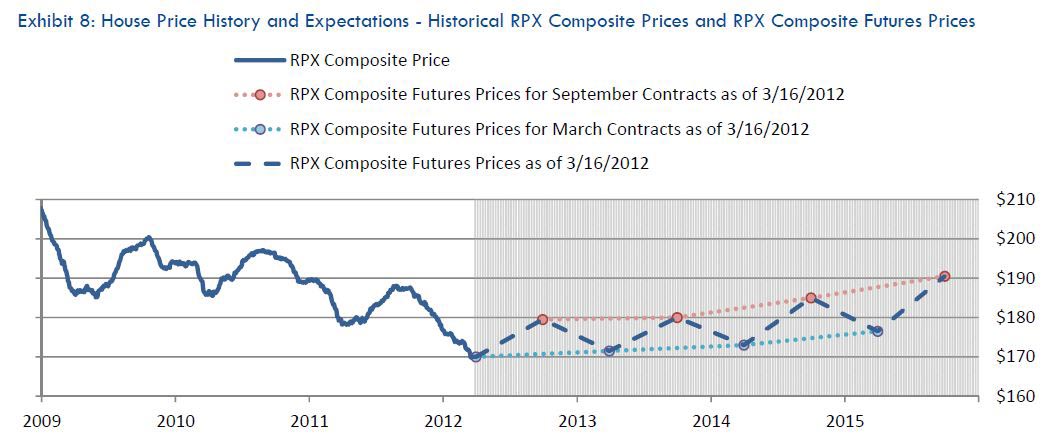
It's all up from here! At least that is the findings from RadarLogic's RPX index which is tied to housing prices nationwide. The index is traded on the Chicago Board Options Exchange and as many indexes has a futures variation as well. Here is a description of the RPX:
For those of you interested in learning more about this, you can find it HERE.
Anyway, what does the futures market for RPX tell us about future house prices? Queue chart please (click to enlarge):
It appears that we are bottoming out at this very moment and prices will move gently upward over the next few years with acceleration after 2015. While this is upward movement, the improvements could best be described as "flat" in the near term. That is still better than the slight sagging the market has experienced since 2009. It also means that housing will continue to be a solid investment in real terms.
Hopefully, the index is right and we can enter a new phase of price stability in the housing market. That should make things better when it comes to getting quality appraisal work done.
First introduced in 2006, RPX converts public source data on completed home sales into a single daily price per square foot (ppsf) representing a true surrogate for point of sale values. RPX represents the best available surrogate for a spot price for the residential real estate market.
For those of you interested in learning more about this, you can find it HERE.
Anyway, what does the futures market for RPX tell us about future house prices? Queue chart please (click to enlarge):
It appears that we are bottoming out at this very moment and prices will move gently upward over the next few years with acceleration after 2015. While this is upward movement, the improvements could best be described as "flat" in the near term. That is still better than the slight sagging the market has experienced since 2009. It also means that housing will continue to be a solid investment in real terms.
Hopefully, the index is right and we can enter a new phase of price stability in the housing market. That should make things better when it comes to getting quality appraisal work done.
Labels:
chart,
economy,
House Prices,
market
Wednesday, December 14, 2011
Coming Off the Mountain: Chart of Ogden Valley House Prices
A reader emailed me the other day and asked the following question:
I know it is just a guess... but when do you think the bottom would be for prices in Eden, Huntsville and Liberty?Excellent question! To answer that I dived into the sales records and produced this chart:
This is monthly data with a 12 month moving average (black line) superimposed over the top. As you can see, the resort area experienced a wild ride as home prices doubled in the space three years! Commensurately, they have been cut in half again in nearly the same time time.
Labels:
House Prices,
investing,
market,
Ogden Valley
Friday, November 18, 2011
The Rent Price Penalty
As with all things in life, risk is tied to compensation. Consumers see this relationship particularly in borrowing money. The payday loan office charges over 300% interest because so many of their loans go to collections. The risk of lending is very high. Banks will increase the interest rates on car loans made to individuals with bad credit. Since most people operate on a fixed budget, the higher interest rate translates into a higher payment for a smaller amount of money. That smaller amount of money translates into a dumpy car.
This same dynamic typically plays out in the housing market. Folks with great credit present a low risk. They can borrow inexpensively. Since their interest rate is low, their budgeted payment allows them to borrow more for the same payment than someone with bad credit and a high interest rate. Thus, those with good credit can afford to live more lavishly than their bad credit friends.
So why do I bring this up? Well, risk runs in many directions. Tenants typically pay more for a rental space than they would if they owned something. However, sometimes the spread is not that great. In fact, during the housing boom, rents were LESS than mortgage payments. That is normally a good indicator of an overheated market.
Today though we have just the opposite situation. Good credit buyers are shunning ownership right now and running to rentals instead. This pushes up demand and rents on the best rental units. How much does it push up the rents? Lets look at a recent example:
459 20th Street (which you may recognize) has been for sale at $89,900. Let's assume that a purchase is based on a 4% interest rate with a $3,150 down payment. The monthly payment for a buyer comes out to $527 (principal, interest, taxes and insurance).
Yet, despite this very low payment, buyers have not been forthcoming. However, we just leased the property to the second tenants to look at the place for $695 a month net.
As you can see in this case, the tenants are willing to pay 32% MORE to rent the property than to own it. That is a remarkable thing.
Even more remarkable is that this is not a rare situation. Demand for rentals is high while demand for ownership is low. That leaves an abundance of bargain homes in the marketplace that need investors to own and rent to tenants for much more than the mortgage payment.
It makes sense to be one of those owners.
Labels:
economy,
House Prices,
investing,
landlord
Thursday, November 17, 2011
Video: Market Seer Explains How World Works
A colleague of mine passed this video along in an email today. I thought I would share this most insightful exchange between an antagonistic British hostess and a hedge fund manager who understands economics. He explains how the housing market works at the very first. (Note: The reasons he cites for the market bust are the exact same reasons real estate is such a great investment right now.):
I hope you found this video as enlightening as much as I did.
Labels:
economy,
House Prices,
investing,
video
Monday, November 7, 2011
We're On The Cusp: Charts Show Prices to Rise or Massive Overcorrection
I had a conversation on Friday with a client about house prices and how the market "feels" like such a good value. My client remarked: "Houses are a better value than they were in 1999 when I got in the business!"
This comment caused me to reflect on market dynamics for a moment. The housing market in Utah peaked in 1999 but the peak we experienced in 2007 was leaps and bounds better. Time has a way of distorting perceptions because of economic changes and inflation. So, to verify if my client's gut feeling was correct, I decided to do some heavy analysis and compare sticker prices with Consumer Price Index "Inflation-Adjusted" prices.
The findings are shocking in my opinion:
First, lets review the above market history since 1979. Let's follow the brown line for a moment. If you purchased a home in 1979 worth $100,000, that home today would be worth approximately $340,000. Between then and now, your home would have declined in value five separate times from five separate market peaks. However, each successive market peak exceeds the previous one which brings you to today's price point.
Now lets look at the blue line. In real "inflation-adjusted" terms, your home would have declined in value for 12 years even though its sticker price was increasing during that same time. Your home's value lagged abnormally behind inflation quite a bit from 1979 to 1992. Then, in the early nineties, this distortion corrected and there was a tectonic increase (both real and nominal) in the value of your home. After peaking in 1999, the real price plateaued and stabilized again until our most recent housing bubble .
The lesson to take away from this is that, when adjusted for inflation, housing is a fairly stable and predictable store of value. Is it any wonder then that it has been such an excellent tool for creating and maintaining wealth?
Now lets look at the latest housing bubble to measure the local market's progress in finding equilibrium.
This chart is the same as the first except we zoom in on the years 1997-2011. Again, here we are looking at inflation adjusted prices. A quick glance at the chart confirms my client's assertion that homes today are indeed a better bargain than they were in 1999. In fact, we are very close to the market trough of 2004. Keep in mind that this data is six months old. Today we may already be at parity with the previous inflation adjusted market trough. We won't know until a few months when today's data is finally released.
Regardless, what we are seeing is that we are at or very near the natural equilibrium point for housing. There are a couple questions now that need answering:
1. Will the market over-correct?
If it does, that will set up the market for another scenario like the early 1990's when real and sticker price values vaulted after lagging behind inflation. I don't know anyone who bought real estate in the early nineties who is doing poorly. It may be wise to watch this metric. An over-correction is a boon for investors and new home owners.
2. If the market does not over-correct, what's next?
Once the market hits its natural equilibrium point, which on this inflation adjusted chart is around the $100,000 mark, will it hit bottom and plod sideways again? If it does, with inflation increasing, that means that house prices will have to increase with it to maintain that equilibrium. This very well might be the case.
Either way, we are at an important junction. We will either enter a super-bargain phase of the market. Prices hold. And it becomes nearly impossible to go wrong purchasing investment real estate because of its relative value to the dollar. Or, the market will start to see rising sticker prices as nominal values try to keep up with inflation.
Whatever happens, it appears that brighter days are just around the corner.
Monday, October 31, 2011
Home Price Hysteria: Triple Dip Drama A Delusion
Headlines today are warning of another forthcoming dip in home prices as a financial analysis firm declares that home prices are headed down again. How far down? Here an except:
So home prices could possibly decline 3.6% between now and June? Pardon me folks if I am simply unimpressed by the alarms being sounded. It is not that I don't believe what they are saying. Rather, I believe that this is a contrived headline and these numbers are inconsequential to us based on the big picture.
The truth of the matter is that house prices have bottomed, bottomed again a few months ago, and will likely bump a bottom again "by next June." To see why this is a non news event, lets take a look at the house price index charts from CalculatedRisk:
As you can see the double dip was really us bouncing along the bottom of house prices. A triple dip will be an even less newsworthy event. House prices have blown off all their excesses and now are operating in the historical price range ratios that are more closely tied to household income instead of household income leveraged to the Nth degree through interest-only and option-arm loans.
This correction in house prices and their return to equilibrium prices becomes even more apparent when you look at prices adjusted for inflation:
Due to Uncle Sam's incessant printing of money, house prices have never really stopped dropping in real terms. Which means that today's house prices are right about in the sweet spot of equilibrium. Even if home prices didn't drop a dime in the next year, the printing presses are still running which means that each year the homes become a better and better value at current sticker price.
Meanwhile, price-to-rent ratios are also showing we are very near to equilibrium:
So, the next time you hear headlines telling you that the sky is falling, be sure to look up. You will likely live to tell the story the next morning...if it's a story even worth repeating.
The besieged housing market has even further to fall before home prices really hit rock bottom.
According to Fiserv, a financial analytics company, home values are expected to fall another 3.6% by next June, pushing them to a new low of 35% below the peak reached in early 2006 and marking a triple dip in prices.
So home prices could possibly decline 3.6% between now and June? Pardon me folks if I am simply unimpressed by the alarms being sounded. It is not that I don't believe what they are saying. Rather, I believe that this is a contrived headline and these numbers are inconsequential to us based on the big picture.
The truth of the matter is that house prices have bottomed, bottomed again a few months ago, and will likely bump a bottom again "by next June." To see why this is a non news event, lets take a look at the house price index charts from CalculatedRisk:
As you can see the double dip was really us bouncing along the bottom of house prices. A triple dip will be an even less newsworthy event. House prices have blown off all their excesses and now are operating in the historical price range ratios that are more closely tied to household income instead of household income leveraged to the Nth degree through interest-only and option-arm loans.
This correction in house prices and their return to equilibrium prices becomes even more apparent when you look at prices adjusted for inflation:
Due to Uncle Sam's incessant printing of money, house prices have never really stopped dropping in real terms. Which means that today's house prices are right about in the sweet spot of equilibrium. Even if home prices didn't drop a dime in the next year, the printing presses are still running which means that each year the homes become a better and better value at current sticker price.
Meanwhile, price-to-rent ratios are also showing we are very near to equilibrium:
So, the next time you hear headlines telling you that the sky is falling, be sure to look up. You will likely live to tell the story the next morning...if it's a story even worth repeating.
Labels:
chart,
House Prices,
investing,
landlord
Thursday, October 27, 2011
Real Estate Investment: Getting the Good Deal
I am working with some clients right now who have been mentored by another investor to cast a broad net over the market to find bargains. Their methodology is to follow a specific formula to derive an offer price and then submit that offer regardless of list price.
My experience has taught me that even though a property may be worth of a specific value, the list price for that same property may or may not reflect its value. In many cases, the list price may be too high. Does this mean that a low ball offer should be submitted to such a property?
A couple of years ago I wrote Blacklisted at 10%: Betting Against The Seller. The article has a very interesting chart showing you the List Price-to-Sale Price rations for single family home transactions in Davis County. What we discovered was that back then most transactions happened at 90% of list price of above. Therefore, the chances of success offering a price below that threshold were very small...something we discovered to be on the order of a 1-out-of-33 chance. My advise then: Don't low ball because it's a waste of time.
In light my new client's methodology, I wanted to revisit the data and see if there were any new trends. I also narrowed the focus to the multi-unit market in Weber County. I present you with today's chart:
What we see here is interesting. Surprisingly, given market conditions, we discover that 13% of all transactions are occurring ABOVE list price. How can this be? Well, remember that list price and sale price are not necessarily the same thing. If a property is listed lower than its current value, which happens 13% of the time according to this chart, then the price will be bid up. Nearly half of all transactions are occurring between 90% and 99% of list price. 16% of transactions are happening between 80% and 89% of list price. And finally, only 8% of transactions are happening below 80% of list price. That means you have to submit over 10 offers at 80% or less of ask price to get one to stick. That is a lot of offers.
So, is it worth the time and effort? That is up to the agent and the client to decide. My preference is to be more analytical and hone in on the deals based on experience and subjective research. However, some folks do things differently.
So, whatever it is you choose to do...happy bidding!
Labels:
chart,
House Prices,
rental
Wednesday, October 26, 2011
Fudgery: Uncle Sam's Mortgage Manipulation Madness
I found this interesting video online today:
New guidelines for refinancing (aka HARP) have come out to "help" homeowners again who are underwater on their homes. After the failure of the first push to modify mortgages, I doubt this push will be any more successful.
My favorite quote from the video:
"Will it be enough? Maybe. Maybe not. But its definitely a step in the right direction."
Really? What direction might that be? Entrenching people in their homes as debt slaves? Creating dis-incentives for bond investors to enter the market so they can lend to folks who actually qualify?
The answer is to let the market find its equilibrium by allowing homeowners who are underwater and lack the income to service their debt to foreclose. Foreclosure eliminates excessive and bad debt. It resets home prices at lower and truly affordable levels that are related to household income and not manipulated according to gimmicky government programs.
Foreclosure is uncomfortable and often traumatizing to the homeowner. However, with so many homes already reset to lower prices, the chances are high that a homeowner will be able to rent a home in the same neighborhood for less than they were paying on their mortgage prior to foreclosure.
Foreclosure is the natural solution to excessive debt. The sooner that nature can take its course, the sooner our economy will be on the mend, and this tough period in history will be behind us.
Labels:
economy,
House Prices,
loan modification,
loans
Thursday, October 6, 2011
Safer Neighborhoods: Ogden's Proposed Gated Community
Recently I have been made aware of efforts to make Ogden's neighborhoods feel safer. One of these efforts includes a proposal to create a unique gated community in Downtown. Here is a map of that neighborhood:
Basically, the proposal includes gating Eccles, Van Buren, and Brinker Avenues at 20th Street and also at 19th Street and Jackson Ave. The four gates would enclose a community of approximately 150 homes, most of which were built in the 1940's.
The idea is to create an environment that would allow home owners to feel safer but also create an environment that makes it more difficult and less opportunistic for criminals.
Interestingly, crime is not necessarily higher in this neighborhood than the surrounding area but rather the geography and street layout provide a unique opportunity to create a gated community with the least amount of infrastructure expenditures. It will also be interesting to see how this kind of project will affect crime statistics once it is completed.
The project is still in the research stage so it will be interested to report on this again as community buy-in gets underway and plans are presented for approval.
Watch for a report on this again in the future.
Labels:
development,
Downtown Ogden,
economy,
government,
HOA,
House Prices,
landlord,
new construction,
regulation
Friday, September 30, 2011
Appraiser Atrocity: Bureaucracy in Real Estate Hell
I just closed with some buyers after spending 75 days working on a small file that would normally take just 35 days. You can read details about the negotiation and price points in JUST SOLD! Bargain Cottage Starter Home.
Once we locked the home up at the $59,000 price point the first thing we did was order an inspection. We found some ticky tacky problems but nothing serious. We then ordered the appraisal. The appraiser came to the home and several days later we received her findings. To our surprise, the appraisal came in low with the appraiser indicating the home's worth at $57,000...the original list price. This was disconcerting because the home was in very good condition for its age and we estimated that the home was actually listed several thousand dollars below its comparable market value.
An examination of the appraisal was shocking (click to enlarge):
A couple things popped out at me on this page. First, the comparables the appraiser used were cash transactions rather than financed transactions as you would normally expect to see with retail owner-occupied homes (homes that are actually comparable to the home my buyers were trying to purchase). A review of the MLS confirmed my suspicions. These comparables are scratch-and-dent BANK OWNED homes! Our appraiser was comparing apples to oranges in her work. Tisk. Tisk.
Five minutes on the MLS revealed traditional non-distressed homes that sold just a block away. After I put our evidence together, my lender and I threw a Hail Mary pass and disputed the appraisal. We were pleasantly surprised when the appraisal management company called us a week later to say that our dispute was successful and the value was adjusted to $60,000. Whew!
Little did we know what kind of waves we had made by succeeding in our dispute. As you can see on the appraisal form, the home called for "Exterior cracked and peeling paint needs to be scraped and painted." When we notified the sellers they immediately scraped and painted the appropriate places. We ordered our Own In Ogden inspection and the inspector passed us off except for a couple interior repairs. Own In Ogden is picky about paint and they could find nothing wrong in their inspection.
Shortly after that, the original appraiser returned to review the paint work. She was unsatisfied and identified several places that were not noted in the original appraisal that needed to be "fixed" according to her. Flustered, the sellers scraped and painted those areas. We called the appraiser back to the property and she refused to sign off on the repairs yet again, this time indicating she could see transition lines where the old paint had been scraped off even though it was all covered in new paint. The appraiser said "I am the eyes and ears of FHA and this needs to be sanded, scrapped and painted to our satisfaction." Wonderful. It cost $150 each time the appraiser had to revisit the property. Someone's ego had been bruised so they were running up the meter.
Finally, the appraiser signed off on the repairs. When the Appraisal Management Companies are done away with and we go back to a free market again, this appraiser will be on my short list.
However, our problems did not stop there. Just a few days before closing, our loan officer received a full page of conditions he needed to fulfill from the underwriter, one of which was a 2nd appraisal! Our closing was delayed a month while we jumped though numerous other hoops. When the underwriter discovered that I was the landlord of the buyers, they tossed out my Verification of Rents as unreliable and instead demanded proof of deposits. It took my bank a full week to pull deposit images of my buyer's rent payments. Finally, the underwriter was satisfied, miraculously waived our 2nd appraisal, and we were able to wrap up our transaction.
In my opinion, the HVCC has been a disaster in the market and has created an appraisal industry rife with bureaucracy and paranoia. I know some very competent appraisers. Unfortunately, our freedom to employ them has been restricted and regulated by Federal law. The sooner this regulation is done away with, the healthier our market will be.
Labels:
economy,
government,
House Prices,
regulation
Thursday, September 29, 2011
JUST SOLD! Bargain Cottage Starter Home
I just closed today with some buyers on this quaint starter home in Ogden. My clients are also my existing tenants who over the past two years have been preparing themselves for home ownership.
This home was listed in May for $57,000. Given the price point, we thought that it might be a real fixer upper. To our surprise, the home was in quite good condition. Given such, I estimated that the home had been listed below fair market value. Nevertheless, we pressed our luck and offered $54,800 while asking the seller to pay for $3,500 in closing costs.
The listing agent called me and we determined there was not enough equity room for the seller to pay closing costs even at the list price. Knowing that we had some headroom on value, we agreed to the idea of increasing the sales price to $59,000. The seller agreed to pay up to $3,500 in closing costs and also participate in the Own In Ogden program. However, the seller would not agree to make any FHA or OIO required repairs. This was a bit of a risk for my buyers because of the age of the home but we felt it was the only way to make the transaction work.
After 75 days, and a long, precarious, and crazy journey, we finally closed. Congrats to the buyers on their first home!
Tenacity certainly pays off!
If you are looking to buy a home, contact me. Bargains abound.
Labels:
days on market,
House Prices,
sales
Tuesday, September 20, 2011
Depreciation Delusions: Why Falling House Prices Don't Matter
There are a few folks out there writing headlines about another down leg in housing prices. Here is one from HousingWire:
For obvious reasons, this kind of headline puts a lot of prospective buyers on the sidelines while they wait for some good batch of housing news to come about.
The questions I ask is: If the market is going to fall another 7%, can it be to anyone's advantage to buy today? Or can anyone make money buying real estate today if it will be worth less tomorrow?
The answer is an emphatic YES! How? The key is buying the right property. There are two kinds of properties in the real estate market 1) RETAIL which is your sparkly shiny homes that are at full market value and 2)WHOLESALE which are the scratch-and-dent bargain bin properties that are typically bank owned, short sales, or estate sales.
Fortunately, wholesale properties can be purchased for anywhere from 90% to 50% of Retail market value depending on condition. What does this mean? Well, it means that you can still pick up a lot of equity in a home in today's market and still keep a majority of that equity even if the market slides 7% or even 15%.
Let's say that you purchase a wholesale property today for $65K. The retail value of the home is $95K. You have $30K equity. Now lets say the market slid 10% over the coming year. Your equity position is reduced to $20.5K. Yet, your net worth is still $20.5K better than it was before you purchased the property. If you waited to buy the property after the market slid you could have purchased it for $58K and its retail value would be about $85K. You would have about $27K equity. The questions one has to ask themselves is: What is the opportunity cost of waiting a year to net a possible $7K in additional equity? Would that time have been better spent by acquiring additional bargains rather that waiting for the "perfect" property at the perfect moment?
Obviously, if you were going to just purchase one property in your entire life and you had the luxury of purchasing whenever you wanted, timing the market exactly right would be to your favor. However, if you are interested in creating wealth through real estate acquisition, this is an unreasonable proposition. Instead, wealth builders look for opportunities as they arise in any market.
Wealth builders and smart home buyers look to the wholesale real estate market for such opportunities.
Another fallacy out there is that owning real estate is not good if there is an overall trend toward lower home prices. House prices are a product of supply and demand with an overlaid component of household income. If population levels are declining like they are in Russia, Iran, Japan and Detroit, you can expect house prices to decline as demand declines and existing structures maintain supply. If economic malaise arrives and wages decline, house prices will decline too. That is what we have experienced as a nation over the last several years.
Keep in mind though, that over the long term that if house prices decline, typically so will the price of milk, clothes, and every other thing that has a price attached to it. We call this deflation. If you own rentals and the rents have declined because of deflation, typically it won't matter much because the cost of living will have declined as well. Your standard of living will be unaffected...that is, unless you have mortgages on your property.
To beat the deflation effect you have to be out of debt on your properties and have little debt elsewhere. This is why I advocate aggressive amortization or sizable down payments on property when possible.
A couple years ago I wrote We're Turning Japanese! and explored this scenario. Here are the charts I put together:
Click to enlarge. The point of this chart was to show where equity was in a financed retail property if long term deflation were to occur.
The other chart I put together shows what happens with a 10% downpayment:
As you can see, it would take a catastrophic hit to house prices over a sustained period to affect equity in retail homes with 10% down payments. Otherwise, equity is sustained and grown over the long haul regardless of long term declines in value.
The way to make this situation even more favorable in the long term is to shorten the mortgage time to 15 years. However, Utah has never and likely never will experience protracted price declines like you see illustrated here. Population growth and limited supply of land will moderate our prices on the downside. Even the worst housing collapse since the Great Depression has only knocked about 15% off Utah's house prices while the U.S. has suffered a 37% decline on average.
The bottom line is that house prices can't go down much more. Even if they do, the wise investors and wealth builders will be pocketing the bargains while they are available now in today's market. Why make money tomorrow when it can be made today?
Bargains abound. Call me and I will show you where they are.
Home prices could dip another 6% to 7%, before hitting rock bottom in early 2012, according to analysts at JPMorgan Chase.
If that is the case, prices will fall about 37% from peak levels reached before the 2008 housing meltdown.
For obvious reasons, this kind of headline puts a lot of prospective buyers on the sidelines while they wait for some good batch of housing news to come about.
The questions I ask is: If the market is going to fall another 7%, can it be to anyone's advantage to buy today? Or can anyone make money buying real estate today if it will be worth less tomorrow?
The answer is an emphatic YES! How? The key is buying the right property. There are two kinds of properties in the real estate market 1) RETAIL which is your sparkly shiny homes that are at full market value and 2)WHOLESALE which are the scratch-and-dent bargain bin properties that are typically bank owned, short sales, or estate sales.
Fortunately, wholesale properties can be purchased for anywhere from 90% to 50% of Retail market value depending on condition. What does this mean? Well, it means that you can still pick up a lot of equity in a home in today's market and still keep a majority of that equity even if the market slides 7% or even 15%.
Let's say that you purchase a wholesale property today for $65K. The retail value of the home is $95K. You have $30K equity. Now lets say the market slid 10% over the coming year. Your equity position is reduced to $20.5K. Yet, your net worth is still $20.5K better than it was before you purchased the property. If you waited to buy the property after the market slid you could have purchased it for $58K and its retail value would be about $85K. You would have about $27K equity. The questions one has to ask themselves is: What is the opportunity cost of waiting a year to net a possible $7K in additional equity? Would that time have been better spent by acquiring additional bargains rather that waiting for the "perfect" property at the perfect moment?
Obviously, if you were going to just purchase one property in your entire life and you had the luxury of purchasing whenever you wanted, timing the market exactly right would be to your favor. However, if you are interested in creating wealth through real estate acquisition, this is an unreasonable proposition. Instead, wealth builders look for opportunities as they arise in any market.
Wealth builders and smart home buyers look to the wholesale real estate market for such opportunities.
Another fallacy out there is that owning real estate is not good if there is an overall trend toward lower home prices. House prices are a product of supply and demand with an overlaid component of household income. If population levels are declining like they are in Russia, Iran, Japan and Detroit, you can expect house prices to decline as demand declines and existing structures maintain supply. If economic malaise arrives and wages decline, house prices will decline too. That is what we have experienced as a nation over the last several years.
Keep in mind though, that over the long term that if house prices decline, typically so will the price of milk, clothes, and every other thing that has a price attached to it. We call this deflation. If you own rentals and the rents have declined because of deflation, typically it won't matter much because the cost of living will have declined as well. Your standard of living will be unaffected...that is, unless you have mortgages on your property.
To beat the deflation effect you have to be out of debt on your properties and have little debt elsewhere. This is why I advocate aggressive amortization or sizable down payments on property when possible.
A couple years ago I wrote We're Turning Japanese! and explored this scenario. Here are the charts I put together:
Click to enlarge. The point of this chart was to show where equity was in a financed retail property if long term deflation were to occur.
The other chart I put together shows what happens with a 10% downpayment:
As you can see, it would take a catastrophic hit to house prices over a sustained period to affect equity in retail homes with 10% down payments. Otherwise, equity is sustained and grown over the long haul regardless of long term declines in value.
The way to make this situation even more favorable in the long term is to shorten the mortgage time to 15 years. However, Utah has never and likely never will experience protracted price declines like you see illustrated here. Population growth and limited supply of land will moderate our prices on the downside. Even the worst housing collapse since the Great Depression has only knocked about 15% off Utah's house prices while the U.S. has suffered a 37% decline on average.
The bottom line is that house prices can't go down much more. Even if they do, the wise investors and wealth builders will be pocketing the bargains while they are available now in today's market. Why make money tomorrow when it can be made today?
Bargains abound. Call me and I will show you where they are.
Labels:
chart,
House Prices,
investing,
loans,
market,
rental,
seller finance
Monday, September 19, 2011
JUST SOLD! Arts and Crafts Era Home - Seller Finance Bargain
You may recall that I just listed this home less than a month ago. One of the special features of this listing was that the seller was savvy enough to offer seller financing terms for the home. The day I listed the property, I presented it to several experienced investors I work with. We wrote an offer the following day.
The seller was savvy but also very cautious in their approach and it took us about a week of fine tuning things to come to terms on the contract.
The transaction was closed at a price of $73,800 (just $1,100 off of list price) after inspections revealed a few maintenance items that were unanticipated. The buyer paid $7,490 as a down payment. The first mortgage payment was due 15 days after closing. The buyer opted for a 15 year note with a payment of $577 and a note rate of 6.5%. The seller asked for and the buyer agreed to a 3 year prepayment penalty in the amount of 6 months interest in the event the buyer refinanced or paid the note off early. Finally, the seller wanted a larger down payment than we ultimately agreed to. However, to appease the seller and reduce risk for all parties involved, the buyer agreed to make capital improvements to the home within 60 days after closing that included installing new kitchen cabinets and finishing some space in the basement.
This home was listed and sold in under 30 days. If you want your home to sell fast and near full price, give me a call and I can show you how it is done.
Labels:
architecture,
House Prices,
investing,
landlord,
seller finance
Thursday, August 25, 2011
FOR SALE: Ogden Arts and Crafts Era Home
I recently listed this home for sale.
This home has been in the same family since its construction in 1909. In fact, the original owner of this home built nearly every home on the block. The home has many amazing original features that have been preserved through time. Such things included the clawfoot tub, dual sink basin, push button switches, brass hardware, butler pantry and more. Check out the video:
The home is 1820 SQFT with a 2 Bed configuration. It is possible to convert the upstairs parlor to a bedroom by installing an armoire. There is also plenty of room to convert the basement to livable space and install another bed and bath. The lot boasts an apple and cherry tree.
The sellers will entertain seller financing on this home under the right conditions and terms. If you are interested in taking a look at this property, let me know. Call for current pricing.
Posted by Jeremy Peterson
Ogden Utah Real Estate Broker
Mountain Real Estate Companies
801-390-1480
Labels:
for sale,
House Prices,
video
Wednesday, August 10, 2011
Short Sale Flatline: Wells Fargo Foregoes Defribulator
I have been working on a short sale recently that experienced an untimely death. In the beginning of July I listed a home in Layton that had a week left before the first scheduled foreclosure auction. Upon submitting the file to Wells Fargo (the 1st mortgage) for review, they postponed the auction.
I listed the property at $169,900 after a CMA showed the AS-IS value at around $160K-$170K. By my estimates, the home needed approximately $15K in repairs and was valued at $195K on post-fixup. We quickly received two cash offers. One at $155K and one at $158K.
Upon submission of the offer we were assigned a negotiator and she ordered a BPO (broker price opinion) on the property. It was handled in about three days. About a week and a half later a I get an email from the negotiator saying:
Counter offering to $195000 or best and final offer ************************** * Counter offer acceptance is subject to senior management approval, mortgage insurance and /or investor approval * No sale transaction is accepted until lender signs written contracts *She then attaches paperwork with the counteroffer price of $155,000...the original offer price! Whoa? I emailed her to clarify the discrepancy for me. After several days, I received no response. So, we kindly filled out the paperwork accepting their $155,000 and sent it back to see if anyone in their office was manning the store.
It took about ten days but the negotiator that sent me that email was suddenly no longer working on our file. Instead I got an email from a new negotiator. After several paperwork tasks, I get an email saying that they are countoffering again at $195K but this time they had the right paperwork to back it up.
The buyers didn't want to budge on their price so the negotiator sent me this note:
The BPO completed on the property suggests $20,000.00 in repairs needed to the property even with the value at $195,000.00. Unless the buyer is willing to provide a higher offer, we will not be able to move forward and the offer will have to be declined. On a different note, I want to inform you that I will be out of the office beginning this afternoon through Friday 8/12. I will be back in the office on Monday 8/15 and will continue with any tasks upon my return. If the file is not moving forward, this would be the reason why. Thank you.I was shocked to get this note. It seems to me that the BPO agent checked a box wrong on their form. Here the bank believes the home is worth $195K AS IS. That is simply not what the market says. I ran follow up CMAs to confirm and sent them to this negotiator. Unfortunately, I sent them about an hour after this guy had left for vacation.
The following Monday I recieved this email from a new 3rd negotiator:
Please be advised that the Short Sale for the property above has been declined by Wells Fargo. If you have any additional questions or would like additional details concerning the Short Sale process, please contact Wells Fargo...Any my immediate response:
What?! We are in the midst of a BPO dispute. [The other negotiator] left for vacation Friday afternoon. He has the BPO dispute findings sitting in his email box which were sent to him about an hour after he left town. So are you saying that the investor would rather take his chances at a trustee sale and/or marketing the place as an REO? I seriously doubt the investor would fare better. Please advise.No response was ever received. The home was put on the docket for foreclosure auction again.
The lesson learned here is that garbage in equals garbage out. When a wild BPO gets done that is 25% over market value, your short sale will almost certainly be in trouble.
Posted by Jeremy Peterson
Ogden, Utah Real Estate Broker
Mountain Real Estate Companies
801-390-1480
Labels:
days on market,
House Prices,
landlord,
short sales
Monday, August 1, 2011
JUST SOLD! Estate Sale Rambler
I just closed recently with a buyer who purchased this well kept rambler. This particular home was an estate sale where the original owner-builder recently passed away and left the home to her family to liquidate.
Our negotiations were tough to make this transaction work. The home is 3,000 SQFT and had been listed at $155,000. However it had not been updated (except for carpet) since the home was built. Following our 90% of list price rule, we offered $145,000 and asked for the seller to pay $5,000 in closing costs. The listing agent felt that our offer would be well received due to his client's eagerness to sell the home.
Unfortunately, things didn't pan out that way when our offer was presented. We received a counteroffer at significantly higher terms. Due too the large number of decision makers involved, it was tough to get a consensus among the children of the deceased owner. Essentially, they were making decisions by committee which makes things really tough in a real estate transaction.
They countered us at $150,000 and paying no closing costs. We responded back with $150,000 but asking for $4,500 in closing costs. The sellers were still unhappy. That is when we negotiated a verbal agreement to $150,000 with the seller paying just $2,500 in closing costs. However, when writing up the addendum, one of the sellers vetoed the agreement and they sent us an addendum where the price was $152,500. Obviously, this was not our verbal agreement and was provocation enough for my buyer to reject the terms and scuttle the transaction.
I felt that the change in terms was an act of bad faith on the sellers part and advised my client to withdraw. However, I told the listing agent to call me if his sellers changed their minds and could honor our verbal agreement. A couple days later I got a call with the agent respectfully asking us to reinstate the contract under our verbal terms. We agreed.
After inspections, we adjusted our price to $149,650. So what does this price point buy you?
It gets you a well kept and nearly original 1968 rambler with new carpet. For a home of this size, type, and condition, this turned into one of the best values of its class in Weber County.
Congrats to my buyer on his new purchase!
Posted by Jeremy Peterson
Ogden, Utah Real Estate Broker
Mountain Real Estate Companies
801-390-1480
Labels:
House Prices,
picture,
sales
Tuesday, June 28, 2011
Ogden Rising: Innovative Partnerships Restore Historic Gems
Here is a home we have been watching in our neighborhood over the last year:
This house is listed with my friend David Willis from Terra Venture Real Estate. Of course, if you are interested in taking a tour of this victorian gem, you know who to contact. ~ Grin! ~
Video Courtesy of KSL.com
This house is listed with my friend David Willis from Terra Venture Real Estate. Of course, if you are interested in taking a tour of this victorian gem, you know who to contact. ~ Grin! ~
Labels:
architecture,
for sale,
House Prices,
victorian
Subscribe to:
Posts (Atom)