Showing posts with label economy. Show all posts

Saturday, February 23, 2013

SEQUESTRATION: Hardship for Weber and Davis Homeowners?


Home prices are directly correlated to median income.  The higher incomes are, the higher house prices will be for a given geographic location.  This phenomena explains how Ogden Victorian homes sell for $80 per square foot while the same home in Salt Lake City's avenues sell for $150 per square foot.  The homes are the same but the household income's of those living in them are different.

Birds of a feather flock together and there is usually a socio-economic self segregation that occurs in nieghborhoods.  In older neighborhoods, it is typically in smaller and more distinct areas, however we see in large suburban developments how homogeneity prevails and expansive communities can be created around a specific income profile.

These large suburban communities are about to be dealt a blow as household income is scheduled to take a very unfortunate turn downward.  The Federal government will enter what is termed "Sequestration", or a fancy term meaning budget cuts, on March 1st.  These cuts will impact Hill Air Force Base beginning April 1st.

So what do these cuts look like?  For starters, sequestration will affect 11,500 workers and will reduce their pay by about $7,000 per employee per year.  That is over $80M that will go missing from Weber and Davis County economies over the next year.  

So how does this affect house prices and the housing market in general?  Well, to get a sense of the impact let's take a look at communities that house the majority of HAFB employees.


The population of HAFB workers affected by this pay decrease is approximately 6.3% of the total population of the communities where they reside.  For ease of calculating, lets assume that everyone else's incomes are not impacted by this change. (Note: In reality, the loss of income will vector throughout the economy by decreasing consumption at local businesses and affect profitability and secondary employment as well.)  If 6.3% of the population receives an 8.5% decrease in pay, the average median income for these communities will decrease by just .54%.   That doesn't seem like a lot.  However, when house prices have otherwise been increasing, a .5% decrease means the difference between a recovering market and a soft buyer's market.

I expect that the price increases we have seen over the past year will slow and flatten in light of these new developments.  We likely won't see meaningful price increases over the next year in these communities. HAFB employees are likely to be found selling and downsizing or possibly even finding themselves in a short sale situation or foreclosure.  If the cuts are permanent, I would expect to see things pick up again in a couple years as the economy adjusts.  If they are not permanent, then we may see an economic surge and housing bounce once pay is reinstated again.

Either way, it is best to have a Professional at your side to aide you.  If you are in the real estate market or thinking of selling your home, CONTACT ME and we will put together a plan that meets your needs.      


Monday, October 8, 2012

Mormon Missionary Age Requirements and Utah's Housing Market


On Saturday, the Church of Jesus Christ of Latter Day Saints announced changes to its missionary program that will have a significant impact on the timeline of social milestones for individuals of the faith. 

For as long as I have been alive, young men have been encouraged to serve missions at the age of 19 and young women, if they choose to serve, at the age of 21.  The mission experience is a right of passage for most who serve and marks a bright line in time between youth and maturity. 

So, the question arises:  Will this change in time frames affect Utah's Housing market? 

First, to understand how it might impact it, we need to know that the housing market is affected by demand for housing.  Demand for housing is a direct result of people seeking shelter for themselves which initially happens as a result of them leaving their parent's home.  While young adults just starting out will tend to rent, newly married couples tend to gravitate toward home ownership.

Since LDS returned missionaries will be coming home at a younger age, will this portend earlier marriage and household formation than has been experienced up until now?  Would these younger married couples complete their studies earlier and purchase their first home sooner than in previous years?  Will these policy changes affect the number of households being formed as well as the shift in time? 

My gut says that this policy change will be felt in the markets slowly enough almost not to be noticed but that it will be have a meaningful contribution as a whole over time.  

Obviously it is too early to tell, but it would make a curious study to see how this church policy change will affect sociological dynamics which ultimately affect the housing economy in the long term.   Perhaps this would be a good thesis paper for a desperate grad student somewhere scouring the earth for a fresh idea.  If you are that grad student...you're welcome.   

Monday, August 20, 2012

Real Estate Market Forecast: Winter Storm Advisory

Over the past several years, I have been watching real estate market sentiment ebb and flow.  Some seasons, my phone rings off the hook, and others, it sits there idle and I wonder why I bother paying such a large cell phone bill.  It is interesting to see how an over arching cosmic vibe affects market activity from day to day.  For instance, on days that the DOW plunges 1% or more, my phone does not ring with client calls.

One of the big events that affected call volume and market activity was the S&P debt ratings down grade of U.S. issued debt.  For two months, the market was nearly vacant of buyers.  I could hear crickets. 

Since that time, I found an index that correlates with my experience of high and low market activity.  The chart is the Gallup Economic Confidence poll.  Here is the chart (click to enlarge) going back to last summer:


 I have circled the period that occurred around the debt downgrade and the national debt ceiling debate.  As you can see, the sentiment drop was quite precipitous.  It took the market almost 6 months just to return to pre-downgrade levels of confidence.  In recent months, confidence has ebbed slightly but nothing incredibly noteworthy.

The reason I bring this up is that we may be in for some choppy consumer confidence conditions starting toward the end of this year.  There are several things that may make for an extra cold market this winter:

Debt Ceiling Debate Redux

According to the Wall Street Journal,  we should be at our maximum debt limit as a nation again by around December 20th.  What a wonderful Christmas present.  Congress will likely be contentiously debating the issue in January to pass another extension.  We can likely anticipate yet another downgrade as a result.  Consumer confidence is likely to suffer as it did last time.

Arrival at The FIscal Cliff

Due to the inability of Congress and the Executive Branch to come up with a solid budget reduction proposal last year, we have The Fiscal Cliff which we are scheduled to cascade over automatically unless Congress and the Executive branch take action to avoid it.  What is it?  It is an automatic income tax increase (cancellation of G.W. Bush's tax reductions from yesterdecade) and the simultaneous cut in Federal spending.  I am all for the spending cuts.  The tax increase will be painful.  Therefore, expect a big hit to consumer confidence in the wake of an over arching tax increase on the population.  Interestingly, economists expect the issue to be dealt with before the year is out.  Yet, the public is not likely to react well as the debate can only produce anxiety while a solution is forged. 

Geopolitical Stress

This may seem way off the radar of for local real estate issues but geopolitical stress can affect consumer confidence as well.  This is especially true when it affect prices at the gas pump.  Currently, the Middle East is a tinderbox and becoming more unstable by the month.  There may be war drums beating and military action in the Middle East after our November election that, if it occurs, will certainly affect oil and gas prices here at home.  Expect consumer confidence to react accordingly.

We live in a turbulent world.  Markets react accordingly.  I anticipate that after experiencing a pleasant chapter of moderation over the last 6 months and for still several more, we may enter a rather choppy period just as we enter the Holiday season.  It is my hope though we will be through the worst of it just in time for the Spring selling season.   

Friday, March 23, 2012

RadarLogic: For House Prices, It's All Up From Here!

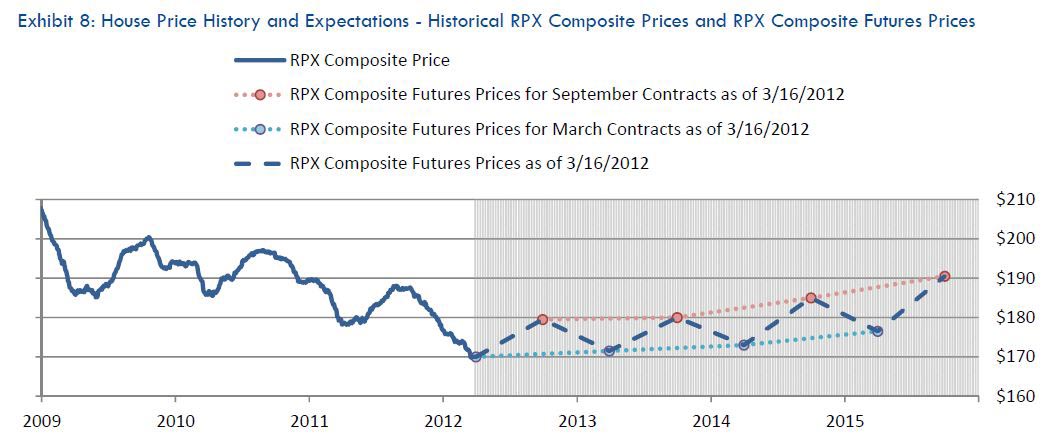
It's all up from here!  At least that is the findings from RadarLogic's RPX index which is tied to housing prices nationwide. The index is traded on the Chicago Board Options Exchange and as many indexes has a futures variation as well.  Here is a description of the RPX:

First introduced in 2006, RPX converts public source data on completed home sales into a single daily price per square foot (ppsf) representing a true surrogate for point of sale values. RPX represents the best available surrogate for a spot price for the residential real estate market.

For those of you interested in learning more about this, you can find it HERE.

Anyway, what does the futures market for RPX tell us about future house prices?  Queue chart please (click to enlarge):


It appears that we are bottoming out at this very moment and prices will move gently upward over the next few years with acceleration after 2015.  While this is upward movement, the improvements could best be described as "flat" in the near term.  That is still better than the slight sagging the market has experienced since 2009.  It also means that housing will continue to be a solid investment in real terms.

Hopefully, the index is right and we can enter a new phase of price stability in the housing market.  That should make things better when it comes to getting quality appraisal work done. 

Thursday, March 22, 2012

Weber County Inventory Snapshot: March 2012

Last October, I posted about Weber County housing inventory levels to see where the hot spots in the markets were. Since that time, it appears that the winter season has caused inventory levels to decline while sales have been fairly consistent over the same period. 

Here is a table of Weber County cities ranked lowest to highest on the Months of Inventory available.


This is a loose measure of where "healthy" markets exist.  We typically like to see inventory levels below 6 months.  Anything above that could be considered a "buyers" market. 

Granted, there are some things that could distort these figures.  This chart doesn't reflect distressed sales as opposed to retail sales.  Nevertheless, it is still a good measuring tool.  It will be interesting to watch the sales unfold this Spring.

Saturday, January 7, 2012

Ogden History: The Henry H. Hudman Home

One of the things that attracted Kim and I to Ogden was its rich history.  The older neighborhoods are teeming with stories and a rich heritage.  One of the things I find interesting is to tie the people together with the homes that they owned.  Often, the history of the home is intriguing in its own right.

This weird fascination of mine took me back to the Weber Title Abstract Vault for some more research on my own home.  Here is the story:


In 1907, the lot at 2227 Jefferson Ave. was owned by Leslie S. Hodgeson.  This name might sound familiar to Ogden historical buffs.  He was the same gentleman that designed the Perry Egyptian Theater, Peery Apartments, Ogden High School, Ogden City Building, Forest Service Regional Building, Shupe Williams Candy Factory, Old Dee Elementary School, Ogden Masonic Temple, John S. Houtz Home, LDS Branch for the Deaf, The Hotel Bigelow, Polk School, and many other structures.  Mr. Hodgeson has probably left more of a mark on the city than any other person.

On October 4, 1907, Henry H. Hudman, the Vice President of Pingree National Bank and the Treasurer for the Blackman Griffin Company, acquired the lot from Mr. Hodgeson for the princely sum of $1,200.  Converted to 2010 dollars, that equates with a $28,000 purchase price...all for a .15 acre lot. Mr Hudman proceeded to construct the home with cash.  A building permit was pulled in 1908 and the home was completed likely in 1910.  We know this because the steam pipes in our basement are stamped with the year 1910 on them.


(This structure existed at the current site of El Matador's at 26th and Ogden Ave.)

The home was constructed for a family of four.  Henry and Anne Hudman had a son and a daughter.  Their son served in The Great War (World War I) and their daughter worked as a stenographer.  The home has a master bedroom with two closets on the main level.  I am sure Mrs. Hudman had the larger walk-in closet with window and Henry was relegated to a much less impressive closet that I use today.

(Located on the 24th block of Washington where the plaza north of Markestar is today.)
On April 29, 1920, Mabel Hudman, the daughter, received a life estate from her parents and it was finally recorded at the county office upon Henry's death in 1937.

Mabel owned the home until October 9, 1952 when Leonard Bauman purchased the home for $9,750 (just $79,000 today).  Mabel seller financed $5,250 of the purchase which the Baumans finally paid off on July, 2, 1969.

The Baumans owned the home for 50 years until 2003 when it was sold to some investors in Salt Lake City for an undisclosed amount.  The investors procured private hard money financing and then proceeded to default.  By early 2005, we had purchased the home from the lender who repossessed it.  We paid $72,500.  A lot of damage was incurred during that short two year period in which the investors owned the property.  It wasn't helped by the fact that the Baumans made their last significant improvement to the property in the early 1970's.

Here are some photos from when we purchased the home:


Cool woodwork. But the cool wallpaper had been ruined.  

Here you can see the shards of glass and the rock (left of the fireplace) that had been thrown through the window. 


The home was coated in wallpaper and it required a lot of scraping to get rid of it all.  You can see the latch on the top of the door.  The investors tried to turn the property into a boarding home.  I am sure that worked for then until the boiler stopped working.


Of course, no old home would be complete without a creepy basement.

The restoration process has been extremely rewarding.  We have grown to appreciate the amount of workmanship that went into home building so long ago.  We look forward to preserving our home for another generation to own in the decades to come.  


Monday, December 12, 2011

Making Ogden Water Realtor Friendly


In a recent Realtor political luncheon held during the Ogden City mayor's race, one of the questions that was posed to the Mayoral candidates was this: What are you going to do to make Ogden City a friendly place for Realtors to do business?

One of the particular complaints Realtors have had against Ogden City over the years is its unhelpful demeanor when it comes to turning on water to vacant homes.

Why make such a fuss about a seemingly small issue?  Well, current loan underwriting standards and traditional market practice have been to conduct inspections and appraisals on property.  These inspections require that utilities be turned on.  If they aren't on, you can't inspect the systems.  If you can't inspect the systems, then the buyer assumes a lot more risk and will either not buy the home or demand a significant price reduction.

So, what? Well, from a city perspective, either one of these outcomes is undesirable.  The city looses water revenue from homes that sit vacant.  Plus, the longer homes sit vacant, the lower their property value goes and thus the assessed property taxes as well.  Putting up road blocks to homes being sold is a lose-lose proposition for the municipal coffers.

I had a conversation today with city staff sharing some of my thoughts.  They assured me that they have been working diligently to change the culture at the Ogden City Utility Department and make it easier for Realtors and buyers to turn the water on to vacant homes.

They asked that Realtors take notes about their experience with the City Utility Department and report in a few weeks to give feedback.  Let's be vigilant and hopefully we can make Ogden one of the most Realtor friendly cities in the county.

If you have any recent experiences you would like to share, please email them to me and I can share those when I report.  

Friday, November 18, 2011

The Rent Price Penalty


As with all things in life, risk is tied to compensation.  Consumers see this relationship particularly in borrowing money.  The payday loan office charges over 300% interest because so many of their loans go to collections.  The risk of lending is very high.  Banks will increase the interest rates on car loans made to individuals with bad credit.  Since most people operate on a fixed budget, the higher interest rate translates into a higher payment for a smaller amount of money.  That smaller amount of money translates into a dumpy car.

This same dynamic typically plays out in the housing market.  Folks with great credit present a low risk.  They can borrow inexpensively.  Since their interest rate is low, their budgeted payment allows them to borrow more for the same payment than someone with bad credit and a high interest rate.  Thus, those with good credit can afford to live more lavishly than their bad credit friends.

So why do I bring this up?  Well, risk runs in many directions.  Tenants typically pay more for a rental space than they would if they owned something.  However, sometimes the spread is not that great.  In fact, during the housing boom, rents were LESS than mortgage payments.  That is normally a good indicator of an overheated market.

Today though we have just the opposite situation.  Good credit buyers are shunning ownership right now and running to rentals instead.  This pushes up demand and rents on the best rental units.  How much does it push up the rents?  Lets look at a recent example:
 
459 20th Street (which you may recognize) has been for sale at $89,900.   Let's assume that a purchase is based on a 4% interest rate with a $3,150 down payment.  The monthly payment for a buyer comes out to $527 (principal, interest, taxes and insurance).

Yet, despite this very low payment, buyers have not been forthcoming.  However, we just leased the property to the second tenants to look at the place for $695 a month net.

As you can see in this case, the tenants are willing to pay 32% MORE to rent the property than to own it.  That is a remarkable thing.

Even more remarkable is that this is not a rare situation.  Demand for rentals is high while demand for ownership is low.  That leaves an abundance of bargain homes in the marketplace that need investors to own and rent to tenants for much more than the mortgage payment. 

It makes sense to be one of those owners.

Thursday, November 17, 2011

Video: Market Seer Explains How World Works

A colleague of mine passed this video along in an email today.  I thought I would share this most insightful exchange between an antagonistic British hostess and a hedge fund manager who understands economics.  He explains how the housing market works at the very first.  (Note: The reasons he cites for the market bust are the exact same reasons real estate is such a great investment right now.):


I hope you found this video as enlightening as much as I did.

Thursday, November 10, 2011

Affordable: House Payments 40% Below 2006 Levels


An interesting headline courtesy of Housingwire this week in Monthly mortgage payment almost 40% cheaper than 2006. Here is an excerpt:

Housing affordability improved dramatically because of declines in both prices and mortgage interest rates, according to David Stiff, chief economist at Fiserv.

"The monthly mortgage payment for a median-priced single-family home is now $700, compared to $1,140 in 2006 — a decline of nearly 40%," he said in comments on the latest release from Fiserv.
Even more interesting is this snippet:

Stiff said national purchase mortgage payments now account for only 13% of monthly median family income, down from 23% in the first quarter of 2006, and the lowest percentage since 1971.

That should give us some historical perspective.  How low can house payments go?  Not much more in my opinion.  The only scenarios that I foresee pushing house prices meaningfully lower would be a pandemic or a Zombie Apocalypse.  


Monday, November 7, 2011

We're On The Cusp: Charts Show Prices to Rise or Massive Overcorrection


I had a conversation on Friday with a client about house prices and how the market "feels" like such a good value.  My client remarked: "Houses are a better value than they were in 1999 when I got in the business!"

This comment caused me to reflect on market dynamics for a moment.  The housing market in Utah peaked in 1999 but the peak we experienced in 2007 was leaps and bounds better.  Time has a way of distorting perceptions because of economic changes and inflation. So, to verify if my client's gut feeling was correct, I decided to do some heavy analysis and compare sticker prices with Consumer Price Index "Inflation-Adjusted" prices.

The findings are shocking in my opinion:


First, lets review the above market history since 1979.  Let's follow the brown line for a moment. If you purchased a home in 1979 worth $100,000, that home today would be worth approximately $340,000.  Between then and now, your home would have declined in value five separate times from five separate market peaks.  However, each successive market peak exceeds the previous one which brings you to today's price point. 

Now lets look at the blue line.  In real "inflation-adjusted" terms, your home would have declined in value for 12 years even though its sticker price was increasing during that same time. Your home's value lagged abnormally behind inflation quite a bit from 1979 to 1992.  Then, in the early nineties, this distortion corrected and there was a tectonic increase (both real and nominal) in the value of your home.  After peaking in 1999, the real price plateaued and stabilized again until our most recent housing bubble . 

The lesson to take away from this is that, when adjusted for inflation, housing is a fairly stable and predictable store of value.  Is it any wonder then that it has been such an excellent tool for creating and maintaining wealth?

Now lets look at the latest housing bubble to measure the local market's progress in finding equilibrium. 


This chart is the same as the first except we zoom in on the years 1997-2011.  Again, here we are looking at inflation adjusted prices.  A quick glance at the chart confirms my client's assertion that homes today are indeed a better bargain than they were in 1999.  In fact, we are very close to the market trough of 2004.  Keep in mind that this data is six months old.  Today we may already be at parity with the previous inflation adjusted market trough.  We won't know until a few months when today's data is finally released.

Regardless, what we are seeing is that we are at or very near the natural equilibrium point for housing.  There are a couple questions now that need answering:

1.  Will the market over-correct?

If it does, that will set up the market for another scenario like the early 1990's when real and sticker price values vaulted after lagging behind inflation.  I don't know anyone who bought real estate in the early nineties who is doing poorly.  It may be wise to watch this metric.  An over-correction is a boon for investors and new home owners. 

2.  If the market does not over-correct, what's next?

Once the market hits its natural equilibrium point, which on this inflation adjusted chart is around the $100,000 mark, will it hit bottom and plod sideways again?  If it does, with inflation increasing, that means that house prices will have to increase with it to maintain that equilibrium.  This very well might be the case.    

Either way, we are at an important junction.  We will either enter a super-bargain phase of the market. Prices hold.  And it becomes nearly impossible to go wrong purchasing investment real estate because of its relative value to the dollar. Or, the market will start to see rising sticker prices as nominal values try to keep up with inflation.

Whatever happens, it appears that brighter days are just around the corner.

Wednesday, October 26, 2011

Fudgery: Uncle Sam's Mortgage Manipulation Madness


I found this interesting video online today:


New guidelines for refinancing (aka HARP) have come out to "help" homeowners again who are underwater on their homes.  After the failure of the first push to modify mortgages, I doubt this push will be any more successful.

My favorite quote from the video:

"Will it be enough? Maybe.  Maybe not.  But its definitely a step in the right direction."

Really?  What direction might that be?  Entrenching people in their homes as debt slaves?  Creating dis-incentives for bond investors to enter the market so they can lend to folks who actually qualify?

The answer is to let the market find its equilibrium by allowing homeowners who are underwater and lack the income to service their debt to foreclose.  Foreclosure eliminates excessive and bad debt.  It resets home prices at lower and truly affordable levels that are related to household income and not manipulated according to gimmicky government programs.

Foreclosure is uncomfortable and often traumatizing to the homeowner.  However, with so many homes already reset to lower prices, the chances are high that a homeowner will be able to rent a home in the same neighborhood for less than they were paying on their mortgage prior to foreclosure.

Foreclosure is the natural solution to excessive debt.  The sooner that nature can take its course, the sooner our economy will be on the mend, and this tough period in history will be behind us.  

Thursday, October 13, 2011

Ogden to Gain 700 Jobs from Massive Home Depot Service Center


It was reported by ABC 4 today that Home Depot has announced plans to open a customer support and service call center in Ogden.

Construction will begin soon on the building and will be completed by Spring 2012.  A location has not been announced but my guess is that it will be in the Business Depot Ogden facility on 12th Street.  This is where CSN Stores recently opened their new center as well. 

Ogden's rise continues...

Friday, October 7, 2011

Weber County Housing Inventory Snapshot: October 2011

A client asked me which markets in Weber County were the "hottest" as far as sales go.  It's an interesting question.  I liken it to asking which body in the cemetery is the warmest.  I was curious myself and ran the numbers.  Here are the findings:

 
This chart measures the "Months of Inventory" available.  In other words, at sales rates over the last 12 months or at the 30-day pace, how long would it take to sell all of the homes that are on the market today. 

Anything under 6 months is considered a healthy market.  Anything over 12 months is considered extremely overstocked.  It appears that the rurul communities of Plain City, Farr West, and Slaterville are doing relatively well along with Hooper.  The upper income communities of North Ogden, Pleasant View, and the resort communites of Eden, Liberty, and Huntsville are still glutted with listings. 

But before you start a pity party, lets take a look at how far we have come from 2009.  Here is a chart I posted a couple years ago:


There was a time when inventory levels were north of 10 months for most of the county.  Check out Eden and Liberty!  Those markets have come a long way to better health today.  Nobody likes an 80 month market time.

The contrast between these two charts shows that the market today is finding an equilibrium point after the shock of the market collapse in 2008.

Thursday, October 6, 2011

Safer Neighborhoods: Ogden's Proposed Gated Community

Recently I have been made aware of efforts to make Ogden's neighborhoods feel safer.  One of these efforts includes a proposal to create a unique gated community in Downtown.  Here is a map of that neighborhood:


Basically, the proposal includes gating Eccles, Van Buren, and Brinker Avenues at 20th Street and also at 19th Street and Jackson Ave.  The four gates would  enclose a community of approximately 150 homes, most of which were built in the 1940's. 

The idea is to create an environment that would allow home owners to feel safer but also create an environment that makes it more difficult and less opportunistic for criminals. 

Interestingly, crime is not necessarily higher in this neighborhood than the surrounding area but rather the geography and street layout provide a unique opportunity to create a gated community with the least amount of infrastructure expenditures.  It will also be interesting to see how this kind of project will affect crime statistics once it is completed.

The project is still in the research stage so it will be interested to report on this again as community buy-in gets underway and plans are presented for approval. 

Watch for a report on this again in the future.

Monday, October 3, 2011

Creating Wealth: Timing the Real Estate Market

It's no secret that one way to build wealth is to buy assets at a low price and sell them at a higher price.  Day traders do this with stocks all the time.  The same is true for real estate investment.  There are bargains in any market but there are more opportunities in a buyer's market.  So how much more time do we have before house prices start increasing again? (In other words: How long will this awesome buying opportunity we are in now last?)  Housingwire gives us some insight:

The U.S. housing market hit bottom this year and will remain flat until 2014, when it will start to slowly recover, said Rick Sharga, an executive vice president with Carrington Mortgage Holdings.
 ~snip~
Banks hold about 800,000 REOs, and three-quarters of those are not listed for sale, said Sharga. Another 800,000 homes are in foreclosure and 1.5 million loans are delinquent.

This "shadow inventory" will slow down a housing market recovery, he said, as monthly foreclosure numbers will remain elevated through 2012 and REO inventories will stay high through 2013.

So, according to the crystal ball, it appears the window of opportunity will be open for another 2 years.  Let's make use of it.  Those who have acquired real estate during this period should be well rewarded in the years to come.  

Friday, September 30, 2011

Appraiser Atrocity: Bureaucracy in Real Estate Hell


I just closed with some buyers after spending 75 days working on a small file that would normally take just 35 days.  You can read details about the negotiation and price points in JUST SOLD! Bargain Cottage Starter Home. 

Once we locked the home up at the $59,000 price point the first thing we did was order an inspection.  We found some ticky tacky problems but nothing serious.  We then ordered the appraisal.  The appraiser came to the home and several days later we received her findings.  To our surprise, the appraisal came in low with the appraiser indicating the home's worth at $57,000...the original list price.  This was disconcerting because the home was in very good condition for its age and we estimated that the home was actually listed several thousand dollars below its comparable market value.

An examination of the appraisal was shocking (click to enlarge):


A couple things popped out at me on this page.  First, the comparables the appraiser used were cash transactions rather than financed transactions as you would normally expect to see with retail owner-occupied homes (homes that are actually comparable to the home my buyers were trying to purchase).  A review of the MLS confirmed my suspicions.  These comparables are scratch-and-dent BANK OWNED homes!  Our appraiser was comparing apples to oranges in her work.  Tisk. Tisk.

Five minutes on the MLS revealed traditional non-distressed homes that sold just a block away. After I put our evidence together, my lender and I threw a Hail Mary pass and disputed the appraisal.  We were pleasantly surprised when the appraisal management company called us a week later to say that our dispute was successful and the value was adjusted to $60,000.  Whew!

Little did we know what kind of waves we had made by succeeding in our dispute.  As you can see on the appraisal form, the home called for "Exterior cracked and peeling paint needs to be scraped and painted."  When we notified the sellers they immediately scraped and painted the appropriate places.  We ordered our Own In Ogden inspection and the inspector passed us off except for a couple interior repairs.  Own In Ogden is picky about paint and they could find nothing wrong in their inspection.

Shortly after that, the original appraiser returned to review the paint work.  She was unsatisfied and identified several places that were not noted in the original appraisal that needed to be "fixed" according to her.  Flustered, the sellers scraped and painted those areas.  We called the appraiser back to the property and she refused to sign off on the repairs yet again, this time indicating she could see transition lines where the old paint had been scraped off even though it was all covered in new paint.  The appraiser said "I am the eyes and ears of FHA and this needs to be sanded, scrapped and painted to our satisfaction."  Wonderful.  It cost $150 each time the appraiser had to revisit the property.  Someone's ego had been bruised so they were running up the meter.

Finally, the appraiser signed off on the repairs.  When the Appraisal Management Companies are done away with and we go back to a free market again, this appraiser will be on my short list.

However, our problems did not stop there.  Just a few days before closing, our loan officer received a full page of conditions he needed to fulfill from the underwriter, one of which was a 2nd appraisal!  Our closing was delayed a month while we jumped though numerous other hoops.  When the underwriter discovered that I was the landlord of the buyers, they tossed out my Verification of Rents as unreliable and instead demanded proof of deposits.  It took my bank a full week to pull deposit images of my buyer's rent payments.  Finally, the underwriter was satisfied, miraculously waived our 2nd appraisal, and we were able to wrap up our transaction.

In my opinion, the HVCC has been a disaster in the market and has created an appraisal industry rife with bureaucracy and paranoia. I know some very competent appraisers.  Unfortunately, our freedom to employ them has been restricted and regulated by Federal law.  The sooner this regulation is done away with, the healthier our market will be.

Wednesday, September 28, 2011

Consumer Unconfidence: Making Hay In A Buyer's Market

One of the sites that I follow is Gallup.  I find their polls quite interesting and a good way to take the temperature of public sentiment on a variety of topics.  One of the topics related to my real estate business is the consumer confidence index.  I have reproduced one of Gallup's charts and adjusted it with a 6 day moving average trend line:

 
My gut feel lately was that the market has changed since June.  Buyer behavior has changed and seller's are increasing in their motivation in general.  Gallup's data here illustrates what my gut had been telling me.  We have had a significant move down in consumer confidence. 

The last time confidence was this low was in 2008 and 2009.  Interestingly, I closed several seller finance transactions during that period.  Similarly, I just closed a seller finance real estate transaction within the last couple of weeks.  Clearly, this shift in consumer confidence changes the way we conduct business.  

Wednesday, September 14, 2011

Mortgage Lending: Signs of Life In The Wasteland

The mortgage lending market has gone through some trauma since 2007.  For illustrative purposes let's liken the damage done to the mortgage lending business to the effects of a volcanic eruption...in this case Mt. St. Helens specifically.

Here is a picture of the as a lush forest pre-eruption.  Look at all those pretty trees living happily basking in the sun.  Think of each tree as a mortgage lender and the abundance and health of the trees in this photo as a representation of the Mortgage Industry in 2007.


Then, trouble brews and a cataclysm befalls the forest as Mt. St. Helens blasts the life out existence.


Uh oh!  Think of this as a visual representation of what happened to the mortgage industry after the housing crash of 2008.

Yet, with every disaster, there is renewal.  Here is a photo shortly after Mt. St. Helens erupted:


This looks like a lifeless moonscape.  How could anything live in this environment?


Well, lo and behold, there is life!

Please forgive the labored analogy.  The point I wanted to make today was that, as in all natural disasters, life goes on and nature has a tenacious way of springing up and clawing its way back from obliteration.  The same goes for the mortgage lending market for housing.  Just this week we get two very interesting headlines from Housingwire:

Redwood Lines Up Another Jumbo RMBS
Redwood Trust, the only company to launch private-label residential mortgage securitizations since the financial crisis began in 2008, is issuing the RMBS.  Redwood will bond 473 loans with a total balance of approximately $375 million.

This is good news!  Morgtage backed securities have been dead for nearly three years with Redwood being the recent innovator and initiating the creation of more of these products.  They anticipate doing another $1 Billions in RMBS this year.  Good for them.  Good for us.

Also we read today:

Banks May Skirt GSE Uncertainty With Covered Bonds
More banks based in the United States will establish covered bond programs to fund future mortgages on the perception of less risk and still lingering uncertainty over private and agency securitization markets, according to Moody's Investors Service.

New covered bond frameworks could take the place of mortgage-backed securities issued by either the government-sponsored enterprises or the private market.

-snip-

"New covered bonds in the U.S. will also not have the low quality assets that were common in pre-crisis residential mortgage-backed securities." Moody's said in a research note released Tuesday. "We expect future U.S. covered-bond deals will have much less market risk following a bank default than pre-crisis U.S. covered bonds because we assume future covered bond legislation will establish mechanisms permitting liquidation of a portion of the pool over a period of time."
What this is saying is that banks are seeing the writing on the wall that Fannie Mae and Freddie Mac's days of market dominance are numbered.  If the demand for home loans is going to be satisfied, banks will need to find other ways of meeting that demand than originating loans and sending them to Fannie or Freddie.  Thus, traditional banks have started to use tools called covered bonds to provide incentives for the creation of new home loans.   

Both of these reports show that the market is innovating and adapting to survive in the inevitable post-government-dominated mortgage market. 

Tuesday, August 23, 2011

Wall Street Journal Praises Ogden, Utah


The Wall Street Journal recently spotlighted Ogden as an important business hub and as a success in transforming itself from a railroad town to a recreation industry magnet.  Here is an excerpt from the article on what they had to say:

Ogden, a small city some 40 miles north of the capital, packs a concentrated punch in the outdoor and recreation industry.  Ogden made headlines in 2002, when it hosted events for the Salt Lake City Olympic Games. Those Olympic facilities, along with acres of pristine mountains, canyons and rivers, are the main reason outdoor-apparel and equipment companies have been moving to town: The site offers a perfect spot for testing new products, and it's easily accessible from a nearby airport that supports direct flights to Europe. What's more, business owners say, the growing base of competing companies in the area push each other to design the best equipment.

Utah has a relatively modest share of the industry; the state estimates it's home to about 5% of the outdoor-products firms in the U.S. Still, companies that expanded in or relocated to Utah have created at least 2,550 jobs in the past six years, according to the Economic Development Corporation of Utah.
Industry goliaths get partial credit for the surge in Ogden. Amer Sports Corp., the company behind Wilson, Atomic and other brands, consolidated its U.S. operations in 2007 and moved them to the town. Quality Bicycle Products Inc., a distributor based in Bloomington, Minn., set up its second location in Ogden in 2010.
The creation of jobs has helped support our real estate market and economy during this tough period.  Let us continue to recruit businesses to our city and keep the momentum that has been created.  Go Ogden!


Posted by Jeremy Peterson
Ogden, Utah Real Estate Broker
Mountain Real Estate Companies
801-390-1480